

Euretina lecturer delineates research challenges, progress, and strategies for addressing knowledge gaps and treatment needs for dry age-related macular degeneration.
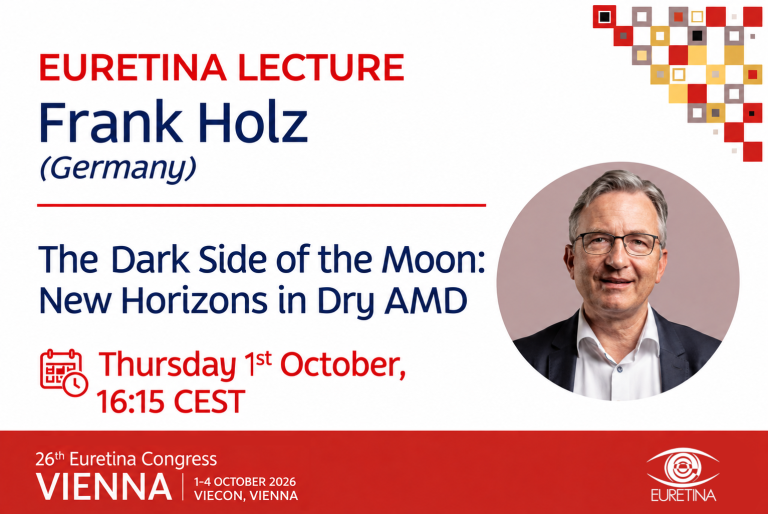
Professor Frank G. Holz, MD, Chairman of the Department of Ophthalmology at the University of Bonn, Germany, has been studying dry age-related macular degeneration (AMD) for more than three decades. During that time, he has made important contributions to advances in image analysis of the disease, understanding its natural history, identifying clinical trial endpoints, and clinical research leading to the approval of therapeutic options.
In delivering the Euretina Lecture during the opening ceremony of the Euretina Congress, Prof. Holz will be looking into at “unknown territory” as he talks about “The Dark Side of the Moon: New Horizons in Dry AMD”.
“We have come a long way in our understanding of how to assess effects of therapeutic intervention in both intermediate AMD and geographic atrophy (GA), and there are now treatments available to slow GA progression and to restore vision in patients with GA secondary to AMD. Unfortunately, there are still many areas that we know too little about,” Prof. Holz says.
“A need remains for more research funding and more interdisciplinary collaboration to support successful ‘missions’ into the unknown territory that will lead us to opportunities for better understanding disease mechanisma, for identifying new therapeutic targets, and, thus, for improving the prognosis and outcomes of dry AMD,” Prof. Holz says.
To begin his lecture, Prof. Holz will put the burden of dry AMD into perspective and outline the challenges that researchers face in developing effective therapies.
“Geographic atrophy accounts for up to 20% of all legal blindness from AMD, and its prevalence almost quadruples every decade after age 50, such that one in every two individuals aged over 90 years is suffering,” he says.
“Research leading to the approval of new therapies is restricted by a need to define more suitable outcome parameters to detect an effectiveness signal. Furthermore, dry AMD is a more complex, multifactorial condition for which there is no ‘golden bullet’. Therefore, treatment for preventing progression of dry AMD and improving vision will require targeting multiple pathways.”
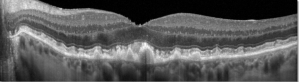
Discussing research challenges, Prof. Holz will point out the absence of an exclusive dichotomy between dry and wet AMD and the fact that dry AMD does not only affect the macular but is now recognised to be a panretinal disease, e.g. with diffuse Bruch’s membrane alterations
He will also review the search for outcome parameters. Although growth in areas of nonfunctioning retina measured with fundus autofluorescence have been accepted as a primary structural endpoint for clinical trials by the US Food and Drug Administration, the European Medicines Agency is still asking for functional endpoints. Prof. Holz will discuss advances that have been made in testing retinal function, including patient-tailored microperimetry and most recently, optical coherence tomography-based inferred sensitivity. He will also discuss the European multicenter MACUSTAR study that aims to identify functional, structural, and patient-reported outcome endpoints for studies of intermediate AMD.
As a final topic, Prof. Holz will review therapeutic approaches, including complement inhibitors that slow progression of GA and the PRIMA system that was shown in a European trial to restore central vision lost from fovea-involving GA due to AMD.
“Combining a subretinal photovoltaic implant and near-infrared light-projecting glasses, the PRIMA system is the first modality that has been able to restore vision in patients with GA related to AMD. Now that it is approved in the European market, the PRIMA system is something that can be offered to patients at our institution and at a select group of other specialised centres throughout Europe,” Prof. Holz says.
Professor Holz will deliver the Euretina Lecture on Thursday 1 October 2026 at 16:15 CEST in Stolz 1.