
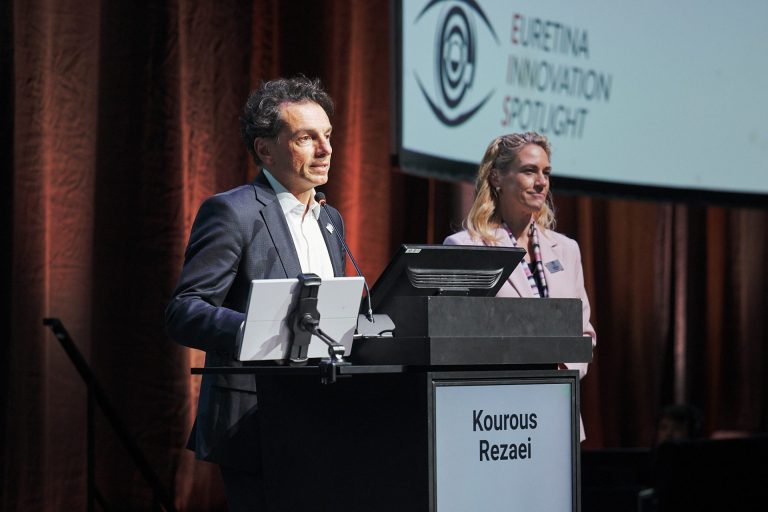
The 4th annual EURETINA Innovation Spotlight (EIS) held on Wednesday afternoon proved again that the programme is a rich educational opportunity for all attendees and a valuable forum for networking and collaboration. Therefore, it is easy to understand why the EIS has become a not-to-be-missed event for physicians, researchers, and industry representatives attending the EURETINA Congress.
EIS 2026 opened with welcoming remarks from EURETINA President, Professor Nicole Eter and EIS Organising Committee Co-Chair, Dr. Kourous Rezaei.Professor Eter said, “When we launched EIS four years ago the idea was simple: innovation in retina happens in many places – in labs, clinics, large companies and small startups, at investors’ desks, and regulatory agencies. Yet those groups rarely sit in the same room and talk openly to each other. EIS was created to be that room. Looking at this audience, I think the idea has worked. We welcome our partners from industry, the startups who bring new ideas and new courage, and the investors who turn promising ideas into real strategies.”
Dr. Rezaei reflected on the growth and success of EIS during its short history, noting that is the largest innovation event in retina in Europe, and its relevance to practicing retina specialists. “This is a great opportunity to see how innovation will shape our practice,” he said. He paid thanks to companies developing innovative products, recognising the challenges they face, and to investors who take the risk in financing an idea to help bring it to fruition.
Both Professor Eter and Dr. Rezaei noted that for the first time, patient organisations are part of EIS. As a special guest, the programme included a young man with RPE65-related retinitis pigmentosa sharing his journey as a recipient of gene therapy and the positive impact it has had on his life.
“In a meeting about innovation, it is easy to talk about molecules, endpoints, and business models and to forget for who we are doing this for,” Professor Eter said.
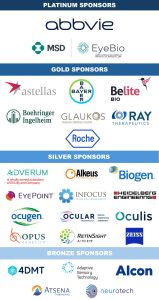
Both Professor Eter and Dr. Rezaei also gave special thanks to the meetings’ industry sponsors whose support makes EIS possible.
Programme details
The presentations at EIS 2026, which were given by high-level company executives, highlighted innovations occurring in the areas of non-neovascular age-related macular degeneration, VEGF-related and other retinal indications, inherited and rare retinal diseases, and retinal surgery and imaging. The talks covered developments in medical/biological therapies, gene therapies, diagnostic and surgical devices, and artificial intelligence (AI)-based applications. Discussions of the content by members of expert panels and answers to questions from attendees in the audience provided additional insights.
On the topic of AI, Dr. Moseley’s keynote lecture titled “AI – an EU Regulators Perspective” provided invaluable information as advancements in these tools are transforming research approaches and patient care.
As in year’s past, EIS 2026 featured an Investor Panel comprised of representatives from several venture capital firms who discussed factors influencing their company’s investment decisions and offered guidance for researchers wanting to gain venture capital support. This year’s panel included Elisa Petris, PhD, Syncona; Roger Zhang, PhD, TCGX Asia; Anta Gkelou, PhD, Sofinnova Partners; and Babak Nemati, PhD, Strategic Intelligence, Inc.
The agenda for EIS 2026 once again included a rapid-fire panel discussion during which representatives from emerging companies had the chance to quickly showcase their company’s strategy in developing cutting-edge treatment options for retinal diseases, moving the field forward. Alistair Laidlaw was among the eight speakers in this session, and he and the other speakers were all presenting on behalf of companies participating for the first time at EIS, that were selected from a field of applicants who submitted a proposal to the EIS Organising Committee.
EIS 2026 also included an expanded poster session. Introduced at EIS 2025, the poster session offers a platform for emerging companies to present their cutting-edge data in posters available for viewing during networking breaks.
EIS 2026 concluded as it began with remarks from Professor Eter and Dr. Rezaei.
“What a day,” Professor Eter said. “I think we have learned so much, and taking all that information together and what is in the pipeline I think the future of retina really looks very very bright.” After thanking all of the participants, Professor Eter said, “I hope we will see each other again not only in the next four days in Vienna, but also next year for the EIS meeting in Copenhagen.”
Dr. Rezaei echoed what Professor Eter said in thanking all attendees and participants. He added, “We had over 1000 registrants and over 45 companies participating and showcasing innovations in retina, all in half a day.” After thanking all of the sponsors who made the event possible, especially the platinum and gold sponsors , he invited everyone to gather outside the meeting room for a glass of wine. “I think you all deserve it,” Dr. Rezaei said.