
Ophthalmologica lecturer discusses the importance and results of randomised clinical trials for guiding treatment of central serous chorioretinopathy, the need from more rigorous evidence, and how it can support personalised intervention strategies in the future.
In 2018 as a PhD candidate at Leiden University, Dr Elon H C van Dijk wrote his doctoral thesis on “Central serous chorioretinopathy (CSC): From pathogenesis to treatment”. Maintaining a focus on that topic, Dr van Dijk has become a leading researcher on CSC and was a co-author of an evidence-based treatment guideline paper published in 2024, and on many other papers on this topic.
Speaking on evidence-based treatment of CSC in his delivery of the Ophthalmologica Lecture, Dr van Dijk says his goals are to increase awareness about this potentially vision-threatening disease and to challenge his colleagues to perform much-needed randomised clinical trials (RCTs) that can help guide optimal intervention. “Central serous chorioretinopathy mainly occurs in middle-aged (30-60 years old) working individuals. Understanding CSC pathogenesis and optimal treatment is of great importance because if persistent, the associated macular subretinal fluid leakage can cause progressive decline in visual acuity and vision-related quality of life. However, CSC also waxes and wanes. Therefore, RCTs that control for the possibility of spontaneous fluid resolution are essential for determining the efficacy of any intervention,” he explained.
Beginning his lecture with a review of CSC pathogenesis, Dr van Dijk will explain that because the disease arises from choroidal abnormalities, this “sick tissue” should be the target for treatment, which also explains why photodynamic therapy (PDT) is more effective than other CSC treatment options Moving on to discuss treatment, Dr van Dijk will review the approaches that have been studied and highlight that based on results from RCTs, verteporfin PDT with reduced settings appears to be the most effective treatment for CSC. He will also present information on focal laser, micropulse laser, and mineralocorticoid receptor antagonists, but caution that while there is some evidence supporting the efficacy of each of those options, the available data are based on use of specific treatment protocols. “I will challenge my colleagues to perform RCTs that could help determine if different device settings or medication dosages work better and particularly in CSC cases with specific characteristics,” he says.
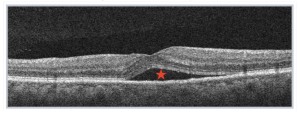
Dr van Dijk will also share his vision for optimising intervention for CSC that both identifies patients who should be treated and the best option for the individual. Such a personalised strategy might consider the broad abnormalities identified in multimodal imaging together with genetic factors that influence treatment response. “Since CSC can wax and wane, ideally, we would like to treat the ‘correct’ patients, meaning those in whom the subretinal fluid will not be self-limiting. My dream is that it will be possible to calculate a risk score that will predict the likelihood of spontaneous fluid resolution and point to the treatment that will be most effective in cases where fluid is expected to persist,” he says.
Concluding his talk, Dr van Dijk will be expressing his gratitude to everyone who has supported him in his research and thank the Euretina Board of Directors for honoring him as the recipient of the Ophthalmologica Lecture award.
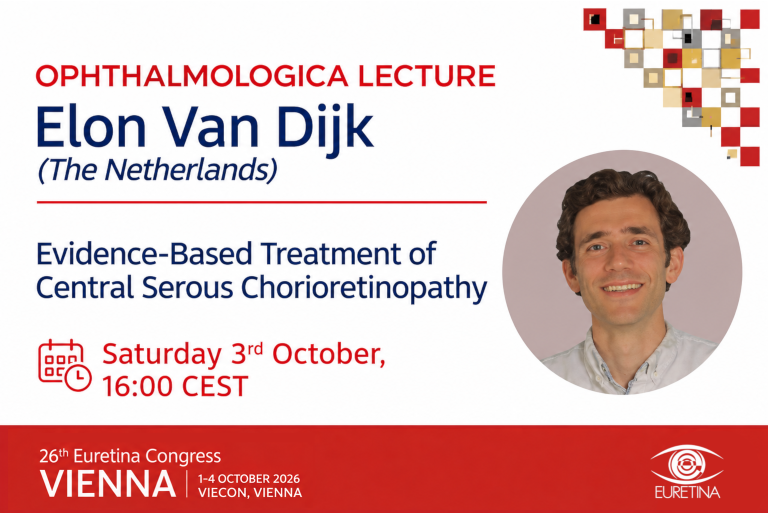
Dr van Dijk will deliver the Ophthalmologica Lecture on Saturday, 3 October 2026 at 16:00 CEST in Stolz 1.