
Kreissig Award lecturer reviews the evidence base and scientific rationale for use of vitreous cavity tamponades in the repair of rhegmatogenous retinal detachment and looks ahead to the possibility of a tamponade-free future.
The Kreissig Lecture at the 26th Euretina Congress will be presented by Professor David Steel (Sunderland, UK). Before delving into his topic, Prof Steel will open with a tribute to Professor Ingrid Kreissig, after whom the keynote lecture is named.
Reflecting on her many contributions to retinal surgery, Prof Steel will highlight Prof Kreissig’s pioneering role in advancing minimally invasive scleral buckling for retinal detachment. “Her textbooks remain seminal, having shaped the practice of countless surgeons worldwide,” Prof Steel says, noting that he still keeps his well-thumbed copy that he carried into the operating theatre with him in the early 1990s when he was first performing buckling surgery.
Of particular relevance to his lecture, Prof Steel will also note a lesser-known aspect of Prof Kreissig’s work: she was the first to describe what is now recognised as pneumatic retinopexy — using intraocular tamponade to close retinal breaks rather than external indentation. Prof Steel’s lecture on tamponades reflects his particular interest in this topic and his belief that an evidence-based approach should be used to guide surgical procedures whenever possible.
“Vitrectomy is now the dominant surgical approach for RRD repair. The fact that an estimated 800,000 vitrectomies are performed annually for this indication worldwide reflects its versatility across the great majority of clinical scenarios. In every case, the surgeon must decide which tamponade will best maximise the outcome, weighing factors such as how long the agent remains in the eye, its effect on vision, whether a second procedure will be needed to remove it, posturing requirements— and, increasingly, the environmental impact of vitreoretinal gases in our warming world,” he says. “Although surgery will always remain an art, many key intraoperative decisions are still guided more by individual surgeon belief than science and published evidence. Tamponade choice is a good example of this”
His lecture will cover:
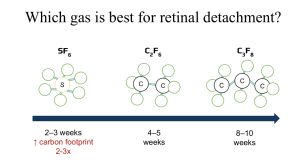
- The evidence base for air, various gases and gas concentrations, and silicone oil in RRD repair
- Strategies for maximising tamponade fill and retinal contact angles for break closure
- Tamponade choice in specific RRD subtypes, such as giant retinal tears
- Posturing strategies for inferior breaks and macula-off detachments
- The role of inferior buckles and viscoelastic (suprachoroidal) buckling techniques
- Heavy versus light silicone oils
- Novel tamponade agents, including two agents in particular that offer new approaches: Vitreodens and Vitreogel
“Vitreodens is an F4H5/oil mixture that behaves like perfluorocarbon liquid intraoperatively but offers postoperative tamponade stability and a refractive index matching vitreous, and Vitreogel is a novel synthetic hydrogel for retinal reattachment. Both can be combined with pharmacological agents to reduce the risk of postoperative complications such as proliferative vitreoretinopathy or cystoid macular oedema.
Concluding his talk, Professor Steel will look ahead to a future where RRD repair is performed using techniques that eliminate the need for a tamponade. Here he will discuss options including immediate retinopexy by thermofusion and placement of retinal patches.
Professor Steel will deliver the Kreissig Lecture on Friday 2 October 2026 at 11:00 CEST in Stolz 1.