

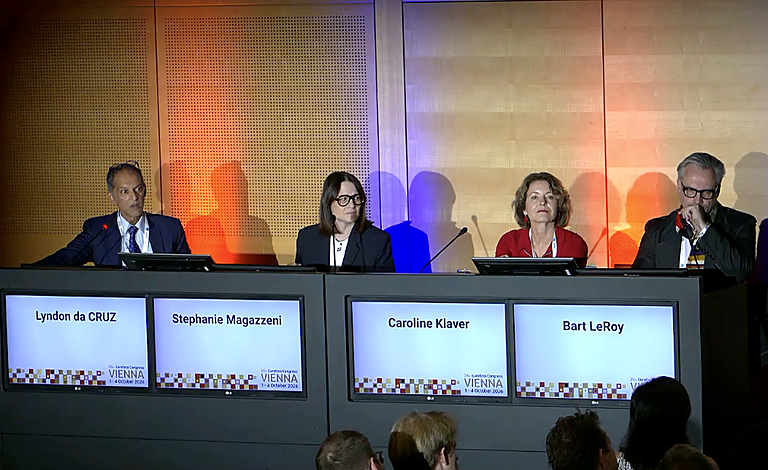
In a busy YOURS session, leading retina specialists shared honest advice on choosing, applying for and making the most of a fellowship, from academia to industry to competitive surgical posts.
Career advice can matter as much as clinical content. That was the thinking behind the YOURS Fellowship Career Clinic, which took place on Saturday 3 October in Stolz 1. Chaired by Kristina Pfau (Bonn, Germany) and Peter Kiraly (Manchester, United Kingdom), the session grew out of feedback from a podcast and webinar on fellowships: many young ophthalmologists wanted to do one but did not know where or how to apply. In Commonwealth countries fellowships are routine, the chairs explained, but in continental Europe they are far less common.
Create your own opportunities
Caroline Klaver (Erasmus MC Rotterdam and Radboudumc Nijmegen) spoke about how two fellowships, at Iowa and at Columbia University, shaped a career as a clinician scientist. At Iowa she shadowed an ophthalmogenetics clinic, studied post-mortem eyes and saw AMD pathology through electron microscopy. At Columbia she learned mutation detection and laboratory methods, and how to bridge the different ways of thinking in the lab and the clinic. Both experiences fed straight back into her work. She set up an ophthalmogenetics clinic in Rotterdam, became a principal investigator on retinal dystrophies and AMD, launched a reading centre that is now developing AI, and leads a Dutch consortium of ophthalmologists, geneticists, biochemists and AI experts. She now offers fellowships herself: epidemiology, statistics and AI in Rotterdam, and medical retina and ophthalmogenetics in Nijmegen. Her advice was to work out your passion and where you want to end up, then “create opportunities for yourself and go for it”. Asked what she looks for in a fellow, she named three things: passion, ambition and openness to learning.
A different route: industry
Stephanie Magazzeni of Heidelberg Engineering, an engineer and PhD with 25 years in the ophthalmic industry, presented a path that rarely comes up when fellowships are discussed. Ophthalmology is one of the most technology-driven specialties, she noted, and industry needs clinicians inside the company, not only as customers. Roles go well beyond medical affairs, into R&D, regulatory and safety, and data validation and AI. She set out the common routes in, from advisory boards and consulting to industry fellowships, direct entry as a medical adviser and founding a start-up, and was candid about the trade-offs. Development cycles can run to 8, 15 years, regulatory work is time-consuming, and science takes up only 20, 25% of her typical day. She suggested trainees ask themselves three questions: do I want to impact patients one at a time or at scale, am I comfortable with long cycles and business trade-offs, and how much clinical practice do I want to keep? Her closing message: your first job “may not be the dream job, but it’s a foot in the door”.
Be proactive, and show up
Bart LeRoy (Ghent University Hospital and Ghent University) described a fellowship at Moorfields that was meant to last a year and lasted three. Among the people he credited as mentors were Jean-Jacques De Laey, Graham Holder, Shomi Bhattacharya and Alan Bird. He also described how he became part of the team behind Luxturna in the United States: he contacted the researchers himself and offered them two fully worked-up patients, then worked at Children’s Hospital Philadelphia one week in five between 2013 and 2020. His advice was to know exactly what you want, be proactive because senior colleagues “have no time to come to you”, work hard, treat nurses and technicians as equals because “they know stuff you don’t know”, ask questions freely and “be a sponge”, and publish. And go to the dinners: if you skip them, “you’re never going to sit next to that hotshot” who decides to invest in you.
Getting a competitive surgical fellowship
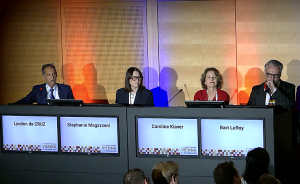
In the panel discussion, Lyndon da Cruz of Moorfields explained how hard the vitreoretinal fellowship is to win. Around 100 candidates apply for five places. Many fall at the first hurdle because they lack the licence, registration or visa for the country they want to work in, however senior they are. Of the 100, roughly 50 could do the job, about 25 are excellent and 10 are shortlisted. For European trainees with limited surgical exposure, he suggested starting with two or three wetlabs, gaining first experience in countries where it is easier to get, spending time in operating theatres, and aiming first for starter fellowships or research attachments at other units. Sort out licensing early if the UK is the goal, and be prepared to apply more than once. “It’s very difficult, but it’s doable.”
Find out more
The session is part of the work of YOURS, the Young Retina Specialists initiative, which represents EURETINA members under 40. Trainees can also apply for the Observership Grant Programme, which offers €1,500 grants to up to ten members a year.